It wasn’t straightforward to find a right moto. The drivers simply didn’t know what I was asking them to. Potoru? Which side of town is that?
Potoru is the village that is the closest to Tiwai Island Wildlife Sanctuary. It’s apparently the place where the scientists first discovered chimpanzees can use tools. Obviously, it’s inhabited by the chimpanzees and there are also pygmy hippos. I have seen wild chimpanzees in my life, in Kibale National Park in Uganda. I have seem hippos but not pygmy hippos. Also, it would be nice to spend a night in a forest. Forests are nice.
Finally a moto driver that knew what I was talking about. We rode to what looked like out of town and stopped in a compound that looked like transport garage. There I was told that there are no cars to Potoru but around 12pm-1pm there will be a bus going there so I might as well wait. The moto driver didn’t give up and told me to go further down the road – we rode until a junction, where the road towards Potoru branched out to the right. The driver said I should pay him what I find appropriate. 5,000le it was.
On the roadside stood a Toyota car. It was going to Bandajuma, which on Google Maps is also marked as Gandorhun or Pohorjun. Google struggles with names of each village, its neighbourhood and district around here. From Bandajuma the people surrounding the car told me I can take moto directly to Tiwai or Potoru.
Long discussion about a price started. I should hire the full car, 350,000le, why not it will take me directly to Tiwai or Potoru. Then I was asked what’s my budget to Tiwai. I said 60,000le, based on Tiwai Island website and Bradt’s estimates. The driver said oh yes, it’s good because the price to Bandajuma is 25,000le from Bandajuma to Tiwai it’s another 25,000le so I will even have space for a beer within my budget. Fine. I’m allowed to sit in front.
As we are waiting for more passengers, I see a wooden shack on which there are words “black coffee” written. Could it be? I look closer and inside I see what my imagination paints as a coffee cup. You know, the small one. I go. Yes! Proudly painted Guinean flag confirms my hope. Black coffee! A Guinean man is running the enterprise. It’s 1,000le and although it’s tastes a bit bland compared to what I had in Guinea (could be the local coffee’s taste, which the owner says is sold by cups of ground coffee, for 2,500le per cup and it’s apparently cheaper than in Guinea, or simply it’s the British taste for blandness that already eroded his taste buds) it’s a joy! I am on my 2nd cup when a man enters the shop and calls me. The car is ready.
Again, I hear how me sitting in front I should pay for two seats because I am “even bigger than 60kg”. I say that I can comfortably sit in the back – where there are four people. In fact there are four women who I see struggling to fit together on the back seat. When I say that it’s not polite to pinpoint someone’s physical flaws I am told that they are just having a little fun with me. True, I sit alone on the front seat and later on I pay for one seat only. Truth be told, because the women in the back were struggling to fit in, my seat is pushed all the way forward, the back seat is positioned full upright. Even if I was way below 60kg I don’t see how two people would squeeze in front.
The road is newly tarred. It’s wide and empty. We soon arrive in Bandajuma. There are already motos waiting.
Tiwai Island? 70,000le. Potoru? 15,000le. Zimmi (35kms behind Potoru towards Liberia)? 70,000le. Where is the 25,000le I was promised by the car driver? Bradt Guide mentions 20,000le from Potoru to Tiwai, Tiwai website says it’s 30,000le from Potoru. But I’m some distance from Potoru. I say I’ll pay 40,000le, the moto drivers are unimpressed. I eat breakfast – 2 hard boiled eggs in bread and ginger juice. It’s early morning, I have time, I can wait till either the price goes down or maybe some other transport arrives. Soon, an Africell pickup truck arrives and stops. I ask for Potoru and I hear 25,000. I say it’s even more expensive than the bike, the driver says yes but bikes are dangerous and less comfortable than the car. I go back to the roadside and stand and wait.
After a while a man comes up to me. Short and wide, says he’s a policeman and asks where I’m going. ”Tiwai? Do you have a transport? No? There are many bikes here waiting? Too expensive? How much do you wanna pay? 40,000? Should I find transport for you for 40,000?”
It takes literally less than a second for him to find a moto for me. The first man he asks is ready. Why was I even standing there for so long? I only say to the policeman that I hope he didn’t bully anyone into taking me. He says no, it’s his duty to help people. This man deserves a front seat in a bus!
Off we go. The road is still tarred but after some time it becomes dirt road, still wide and flat ready for the tar to be lied down. Bradt Guide was updated in 2017 and they express hopes that the road will be all tar now. Ha. Ha. Ha.
We take a left turn at one point and through Potoru, which seems like an overgrown village, we ride through the bush on narrow red roads towards the village of Kentemba. It’s a beautiful ride, through palm – as the people call it there – gardens.On arrival in Kentemba, which is located at a riverside and this is where one takes a boat to Tiwai Island, price included in accommodation fee, a man approached me and led down to a small jetty. Going down, I passed a tourist! A white man, walking up! We only exchanged hellos.
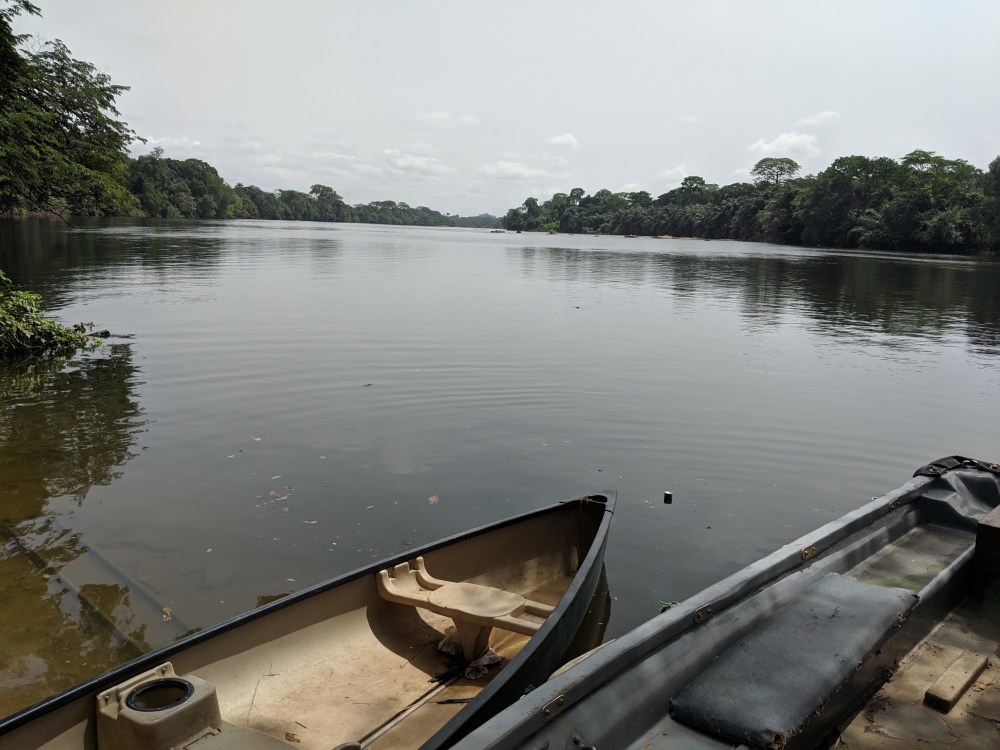
The ride across the river is pleasant, the water in the river crystal clear, we picked up a man with a small girl, who was the overseer of the camp.
The camp doesn’t look too nice. There is a ruin of a house – there was a storm 2 years ago which destroyed all structures and for some time there was no accommodation available – there is a building that stores a kitchen and a fridge with drinks. There is a social place, with tables and chairs and a bed that in Polish I’d call kanadyjka and two small tents set up under a roof. There are toilets and showers (water taken directly from the river) and smaller roofed structures which hold small tents under the roof. The tents are for sleeping. I’m a bit disappointed as I thought the tents will be more exposed to nature. I stayed in a similar camp in Nigeria and there you stay in small tented houses with nets instead of walls among the vegetation – a very nice experience. Oh well, here this is what I have.
The caretaker explains to me what can be done here. Only two trails are for me to explore alone. The accommodation price is 255,000le, breakfast included. Lunch and dinner are – African food – 45,000le each. Long walk – to see chimpanzees – is 50,000le. Night walk – to see pygmy hippos – is 50,000le. Shorter forest walks are 30,000le. Boat rides on the river are 100-150k. There is no mobile reception anywhere near.
I ask for dinner, long walk and night walk. A man named Ibrahim is my day guide. We set off almost immediately, at 12pm. About 20meters from the camp we see red kolobo monkeys. Just a few days ago I had read an article in The Guardian that it’s a critically endangered animal, on the verge of extinction. Doesn’t look like that here, there are many of them and they make good noise.
We have not seen chimpanzees although Ibrahim tried. We walked animal paths, often Ibrahim used machete to cut our way through the bushes. We saw a cobra nest, empty. Ten minutes later, a cobra passed by. I swear it looked dark green but Ibrahim says it’s black. We saw one more cobra hiding under a branch later. It was a three-hour-walk, very enjoyable despite no chimps. Ibrahim didn’t talk much, I think he didn’t speak much English. Often we heard hornbills flying above us, their wings make a whooshing sound as if the birds were ten times bigger than they are. We also saw pygmy hippo footprints. How pygmy is pygmy hippo? A normal hippo is about 800kg, is pygmy 400kg?
A lot of times I hit the plants with my head and stuff was falling on me. I sprayed myself with mosquito spray but on the back and on an elbow I got bitten by things. Not that I noticed any insects on me, I only felt the bulges in the evening and next day my right elbow was quite swollen.We came back at 3pm, on our way back we saw Diana monkeys. There is a research station not far from the camp, the buildings all brand new after the storm catastrophe of 2017 but empty. Research station, abandoned, surrounded by jungle? Think Zone X from Southern Reach trilogy.
After we came back Ibrahim left back for the village. I was all by myself. Lying on kanadyjka I was reading Segu by Marisa Kondé, an epic novel about West Africa and its struggles with Islam and itself. Beautiful story.
The night came and I was still alone. There is beer but it’s locked behind the door. Good I brought enough water with me – I finished a bottle during the walk with Ibrahim. The men actually topped up my bottle with water they carried in a cannister from the village which they claimed is potable. I have a friend who’s working with water and she is very concerned with contents of water and who’s drinking from her bottle (hint: noone is allowed) but even she said she wouldn’t have problems with drinking water from the wells untreated.The problem however lies with the cannister they poured their water from – my bottle smelled of… fuel. Water also had a weird aftertaste.
The first man showed up at 7:40pm. I counted time well as I didn’t eat since morning and was hungry. He brought a mountain of rice and chicken in a sauce – it was very good and I didn’t leave anything behind. The man however forgot the key to the beers. I also asked about the night walk and he said it’s around 10pm.
Finally after more people came from the village and the caretaker had gone back to the village to fetch the beer key I could have a bottle of Star.
The rain came. We left for the night walk at around 9:30pm. I didn’t carry anything with me except the flashlight as I thought the walk would be short. Soon however Bobo, my night guide, who was a bit more talkative than Ibrahim, told me we would walk for two hours.
Again, we walked animal paths. It was very atmospheric. I was wondering what I’d do if we came across an even 200kg pygmy hippo on our way. We didn’t. We saw some small rodent-like animals on the trees – they are I think easier to spot at night because the light from the torch is reflected by their eyes. We saw gelago (Bobo claims it’s an English name, I didn’t research it yet), a poda, which is small and moves very slowly but according to Bobo can actually hunt and catch a monkey (!).
We came back after 11pm. I removed the outer layer – the tropik – from my tent so that only the inner layer is left, the net and I immediately fell asleep.

 Coming back to Maman